
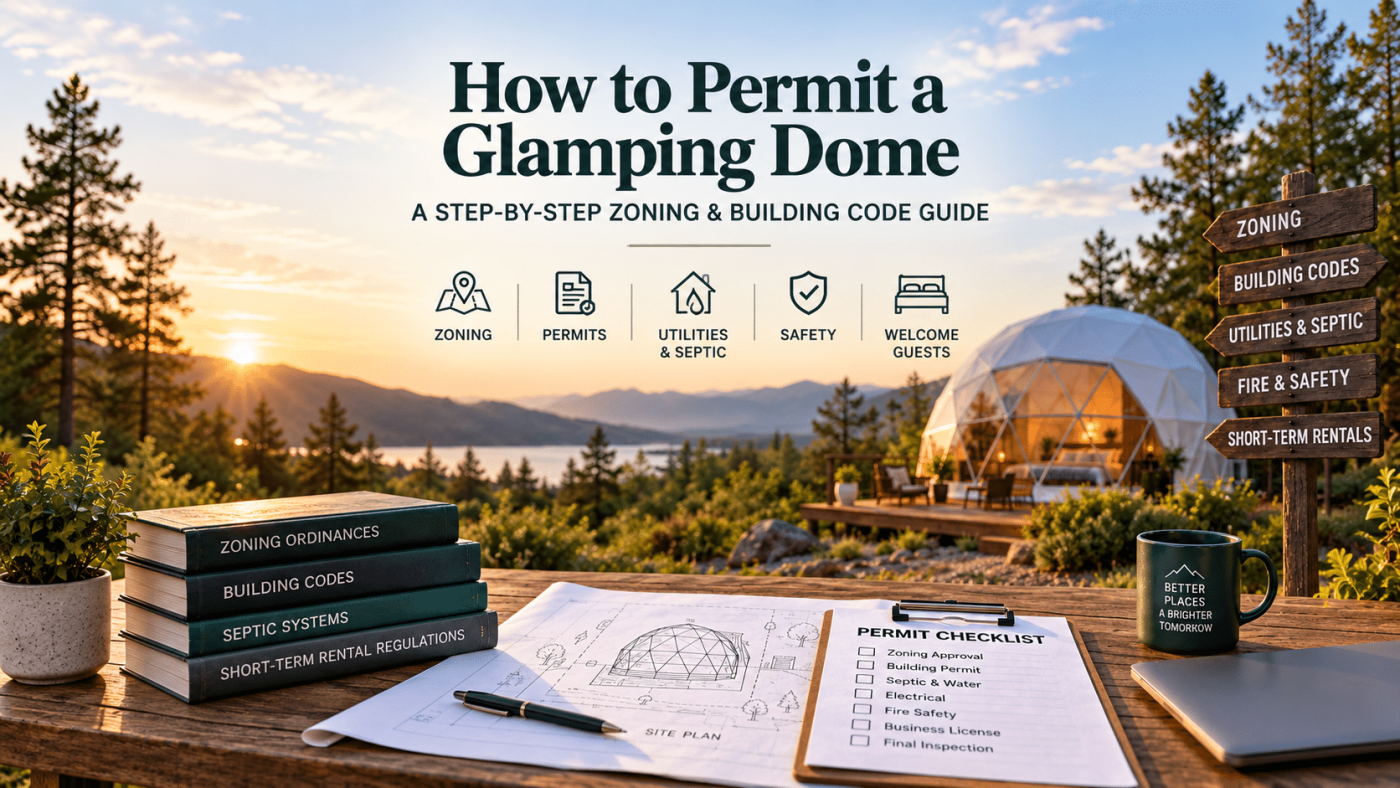
A glamping dome can be a unique way to create a memorable outdoor accommodation, but putting one on your property involves more than choosing a location and assembling the structure. Depending on where you live and how you plan to use the dome, you may need to address zoning, building codes, septic systems, utilities, fire safety, and short-term rental regulations.
The good news is that the permitting process becomes much easier when you approach it in the right order.
This guide explains how to navigate geodesic dome permitting, understand glamping dome zoning laws, and determine what you may need to build a glamping dome legally.
Important: Permitting requirements vary by state, county, and municipality. Always confirm requirements with your local planning and building departments before purchasing or installing a dome.
1. Determine How Your Glamping Dome Will Be Classified
Your first step is finding out how your local authority will classify the dome.
A geodesic dome could potentially be treated as an accessory structure, temporary structure, campground accommodation, short-term rental, or another type of commercial lodging. The classification can significantly change which approvals you need.
For example, a dome used occasionally as a private recreational shelter may be treated differently from a permanently installed dome with a bathroom, kitchen, electricity, and paying overnight guests.
DomeSpaces offers camping domes that can be configured with electrical and water connections and different wastewater options. However, the availability of these features doesn’t determine how your local authority will classify or permit the structure.
Don’t assume that calling your dome a “tent” means it is exempt from building or zoning requirements. A structure’s actual use, installation method, utilities, and permanence can all affect how it is regulated.
2. Check Your Property’s Zoning Laws
Before buying a dome, determine whether your property can legally be used for the purpose you have in mind.
Start by identifying your property’s zoning district through your county or municipal planning department. Then review the zoning ordinance for permitted uses.
Look for terms such as:
- Short-term rental
- Vacation rental
- Bed and breakfast
- Campground
- RV park
- Tourist lodging
- Recreational lodging
- Agritourism
- Guest accommodation
The important question isn’t simply “Can I put a structure here?” It is “Can I operate this structure as paid overnight accommodation here?”
If “glamping” isn’t specifically mentioned in the zoning code, ask the planning department whether your proposed use fits an existing category or requires a special or conditional-use approval.
You can also review DomeSpaces’ FAQ for general information about geodesic structures, but local zoning officials should make the final determination for your property.
3. Check Site and Building Code Requirements
Once you know the proposed use is allowed, determine whether the specific site and dome design comply with local requirements.
Site requirements
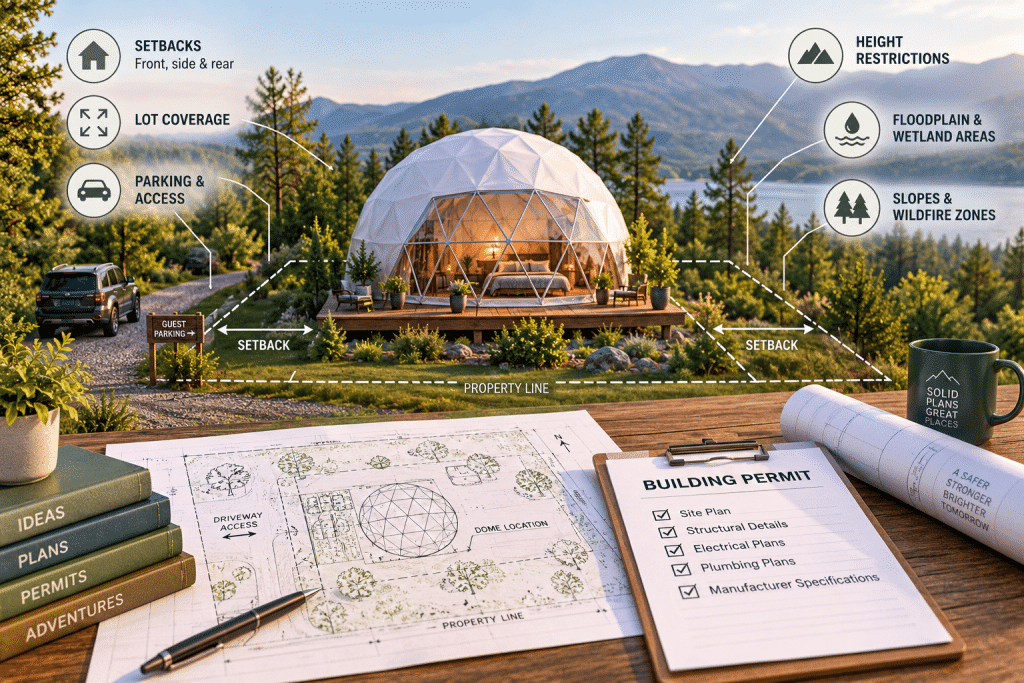
Your local code may regulate:
- Front, side, and rear setbacks
- Maximum building height
- Lot coverage
- Parking spaces
- Driveway access
- Emergency vehicle access
- Distance from property lines
- Floodplain and wetland restrictions
- Steep slopes or wildfire-prone areas
The location of the dome can therefore matter just as much as the dome itself.
For properties in designated flood-hazard areas, additional development permits may be required. FEMA guidance notes that communities participating in the National Flood Insurance Program must regulate development in designated special flood hazard areas and require appropriate permits before development or construction proceeds.
You can review FEMA’s floodplain development guidance when evaluating a property in a flood-prone area.
Building requirements
Whether you need a building permit depends on the jurisdiction and the characteristics of your dome.
Potential triggers include:
- Permanent installation
- Foundation or deck construction
- Electrical connections
- Plumbing
- Heating or cooling systems
- Residential or lodging use
- Structural anchoring
Structural requirements may also account for local wind, snow, and seismic conditions. The appropriate dome frame and anchoring system can depend on these loads; DomeSpaces notes that frame requirements vary according to snow and wind loads.
Your building department may request a site plan, floor plan, structural information, foundation details, manufacturer specifications, or engineering documents.
4. Determine Whether Campground or RV Park Rules Apply
One dome used as an individual rental may be regulated differently from a property containing five, ten, or twenty rentable domes.
Once you begin developing multiple accommodation sites, the local government may consider whether the property functions more like a:
- Campground
- RV park
- Glamping resort
- Commercial lodging facility
- Recreational accommodation facility
This distinction can introduce additional requirements for roads, parking, sanitation, site density, fire access, common facilities, and emergency services.
For larger projects, DomeSpaces’ multidome options may be useful when planning the physical layout. However, confirm the property’s regulatory classification before designing the entire site.
5. State-by-State Glamping Dome Permitting Guide
There is no single nationwide “glamping dome permit.” The approvals you need depend on how your dome is classified, how you plan to use it, and where your property is located. In most cases, zoning and building approvals are handled at the county or municipal level, while state agencies may oversee lodging licenses, wastewater, taxes, or other specialized requirements.
If you’re planning a glamping project in a popular destination such as Florida, Colorado, or Arizona, here’s what you should know before getting started.
Florida: Check Zoning, Lodging, and Septic Requirements
Florida can be an attractive market for glamping, but a project may involve several different approvals.
Start by contacting the county or municipality where the property is located. You’ll want to confirm that overnight commercial accommodation is permitted and determine whether the dome would be classified as a short-term rental, campground accommodation, recreational lodging, or another use.
If your dome qualifies as a vacation rental dwelling or another type of public lodging establishment, you’ll also need to review Florida’s state licensing requirements. The Florida Department of Business and Professional Regulation (DBPR) provides a Vacation Rental Dwelling License application, which is the appropriate starting point for applicable vacation-rental licensing.
Wastewater is another important consideration, particularly for properties without municipal sewer. Florida’s onsite sewage permitting requirements are handled through the Florida Department of Environmental Protection and, depending on the county, local health departments. A septic application may involve a site evaluation, site plan, building floor plan, and other documentation.
If you’re planning multiple domes, additional campground or recreational vehicle park requirements may also apply, including requirements related to water supply, sewage disposal, site layout, and individual spaces.
Before moving forward, confirm three things: whether the use is allowed on your property, which lodging classification applies, and whether your water and wastewater systems can support the planned guest occupancy.
Colorado: Start With the County or Municipality
Colorado is a good example of why local research is essential. Short-term rental and land-use requirements can vary between counties and municipalities, so there isn’t a single statewide process that applies to every glamping project.
Begin with the planning department for the county or municipality where you want to build. Ask how the proposed dome will be classified and whether overnight commercial use is permitted on the property.
For example, unincorporated Larimer County has a specific process for lodging facilities and short-term rentals. Depending on the property and proposed use, applicants may need planning approval, building permits, a life-safety inspection, and a Certificate of Occupancy. The county also offers a pre-application process to help property owners determine which requirements apply.
You can review the Larimer County short-term rental requirements before contacting the county.
The distinction becomes even more important if you’re planning multiple domes. A single dome rented to guests may be considered an STR, while a larger development could be evaluated as a campground, resort, lodging facility, or another commercial use.
For Colorado projects, the safest approach is to have the county or municipality determine the land-use classification before finalizing your site plan or ordering multiple domes.
Arizona: Look at Both Local Approval and State Requirements
Arizona requires glamping operators to consider local land-use regulations alongside state lodging and tax requirements.
Your first step should be contacting the city or county planning department. Confirm that commercial overnight accommodation is permitted on the property and ask how a geodesic dome would be classified. This is particularly important if you’re deciding between treating the project as an STR, campground, or another type of lodging.
At the state level, the Arizona Department of Revenue treats short-term lodging of fewer than 30 days under its transient lodging rules. Businesses providing taxable lodging may need an Arizona Transaction Privilege Tax (TPT) license. You can review the Arizona TPT license application to determine whether registration applies to your operation.
Local campground regulations can add another layer of requirements. Coconino County, for example, requires plan review for campgrounds and distinguishes between temporary tents and more permanent structures. This illustrates why you shouldn’t assume that a geodesic dome will automatically be treated as a tent.
If the dome is permanently installed, connected to utilities, and designed for overnight occupancy, its classification may be different from that of a temporary camping structure.
For Arizona, verify the land use first, then determine which lodging, campground, tax, building, and utility requirements apply to your specific project.
6. Get Water, Septic, and Utility Approvals
Utilities are one of the most commonly overlooked parts of a glamping development.
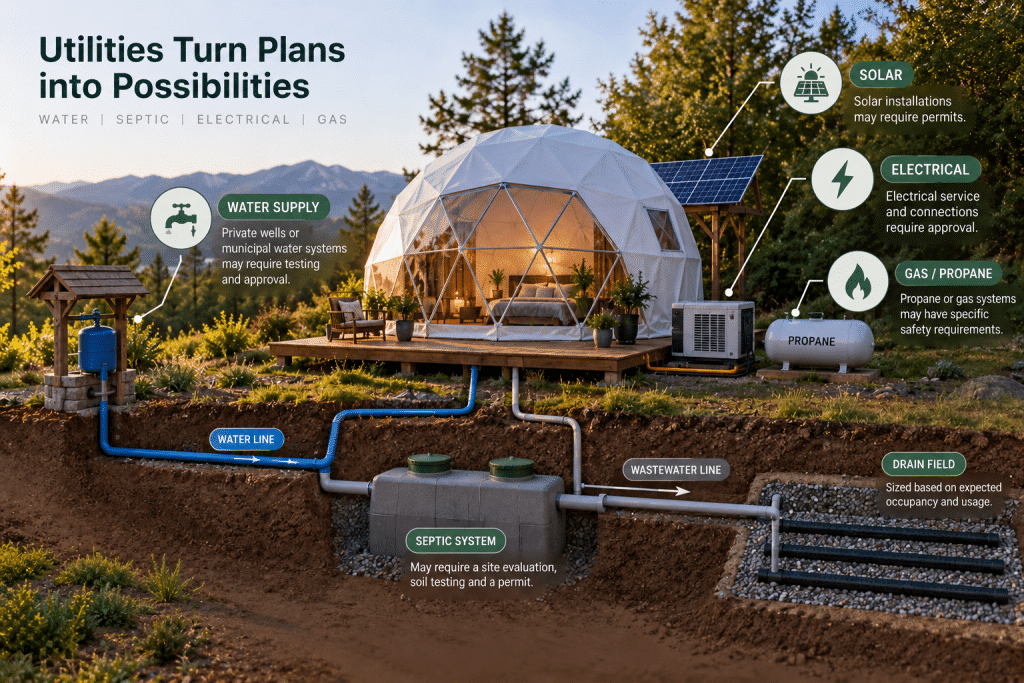
A dome may be relatively simple to assemble, but adding a bathroom, kitchen, shower, or other plumbing fixtures creates wastewater and water-supply requirements.
If the property isn’t connected to municipal sewer, determine whether the existing septic system can support the proposed guest occupancy. An existing residential septic system may not automatically be adequate for a commercial accommodation with additional bathrooms, showers, or guests.
Your local or state authority may require a site evaluation, soil testing, septic permit, system design, or capacity assessment.
You may also need approval for:
- Private wells
- Drinking-water systems
- Electrical service
- Plumbing
- Gas or propane systems
- Generators
- Solar installations
DomeSpaces camping domes can be configured with electrical and water connections, solar or generator power, and different wastewater options. But those options don’t automatically mean they are approved for your particular property.
7. Address Fire, Safety, and Short-Term Rental Requirements
If guests will sleep in the dome, safety requirements become particularly important.
Depending on the jurisdiction and classification, you may need to address:
- Smoke and carbon-monoxide alarms
- Fire extinguishers
- Emergency exits and egress
- Fire access
- Occupancy limits
- Emergency lighting or signage
- Wildfire requirements
You should also investigate short-term rental and business requirements. These may include an STR license, business license, lodging taxes, inspections, or occupancy restrictions.
The exact requirements depend on how the local authority classifies the dome and property.
Glamping Dome Permitting Checklist
Before construction begins:
- Confirm the property’s zoning district.
- Confirm overnight commercial accommodation is permitted.
- Determine how the dome will be classified.
- Check setbacks, height, parking, and site restrictions.
- Determine whether a building permit is required.
- Confirm structural and anchoring requirements.
- Check septic and wastewater capacity.
- Confirm water and electrical requirements.
- Determine whether campground or RV regulations apply.
- Check fire, safety, accessibility, and STR requirements.
- Submit the required applications and plans.
- Complete inspections before accepting guests.
Common Glamping Dome Permitting Mistakes
Assuming a dome is automatically a tent
The appearance of a structure doesn’t determine its legal classification. Construction, permanence, utilities, and intended use can all matter.
Checking building codes but ignoring zoning
A dome can meet structural requirements and still be prohibited for commercial lodging on a particular parcel.
Installing before getting approval
Putting the dome, deck, septic system, or utilities in place before receiving the required approvals can create costly compliance problems.
Assuming existing utilities are sufficient
Your property’s current septic, well, electrical, or driveway capacity may not be adequate for paying guests.
Assuming one dome approval covers future expansion
Adding multiple units can change the property’s use, occupancy, infrastructure requirements, or zoning classification.
FAQs
Do geodesic domes need a building permit?
It depends on the jurisdiction and how the dome is installed and used. Permanent, occupied, or utility-connected structures are more likely to trigger building requirements.
Can I put a glamping dome on residential property?
Possibly, but residential zoning doesn’t automatically permit commercial overnight accommodation. Check zoning and STR regulations first.
Do glamping domes need septic?
If the dome has toilets, showers, sinks, or other plumbing and isn’t connected to public sewer, an approved wastewater solution may be required.
Can I build multiple glamping domes on one property?
Potentially, but multiple rentable units can trigger campground, commercial lodging, density, parking, sanitation, and fire-safety requirements.
Final Takeaway
The smartest way to build a glamping dome legally is to start with the property—not the dome.
Confirm the zoning classification and permitted use first. Then work through site restrictions, building requirements, campground or STR rules, septic and utilities, and fire and accessibility requirements.
Once you know what the jurisdiction allows, you can select and configure the right dome for the property. If you’re still evaluating your options, you can explore DomeSpaces’ dome collection and compare structures based on your intended use, site, and guest experience.
Writer : Neha Verma


